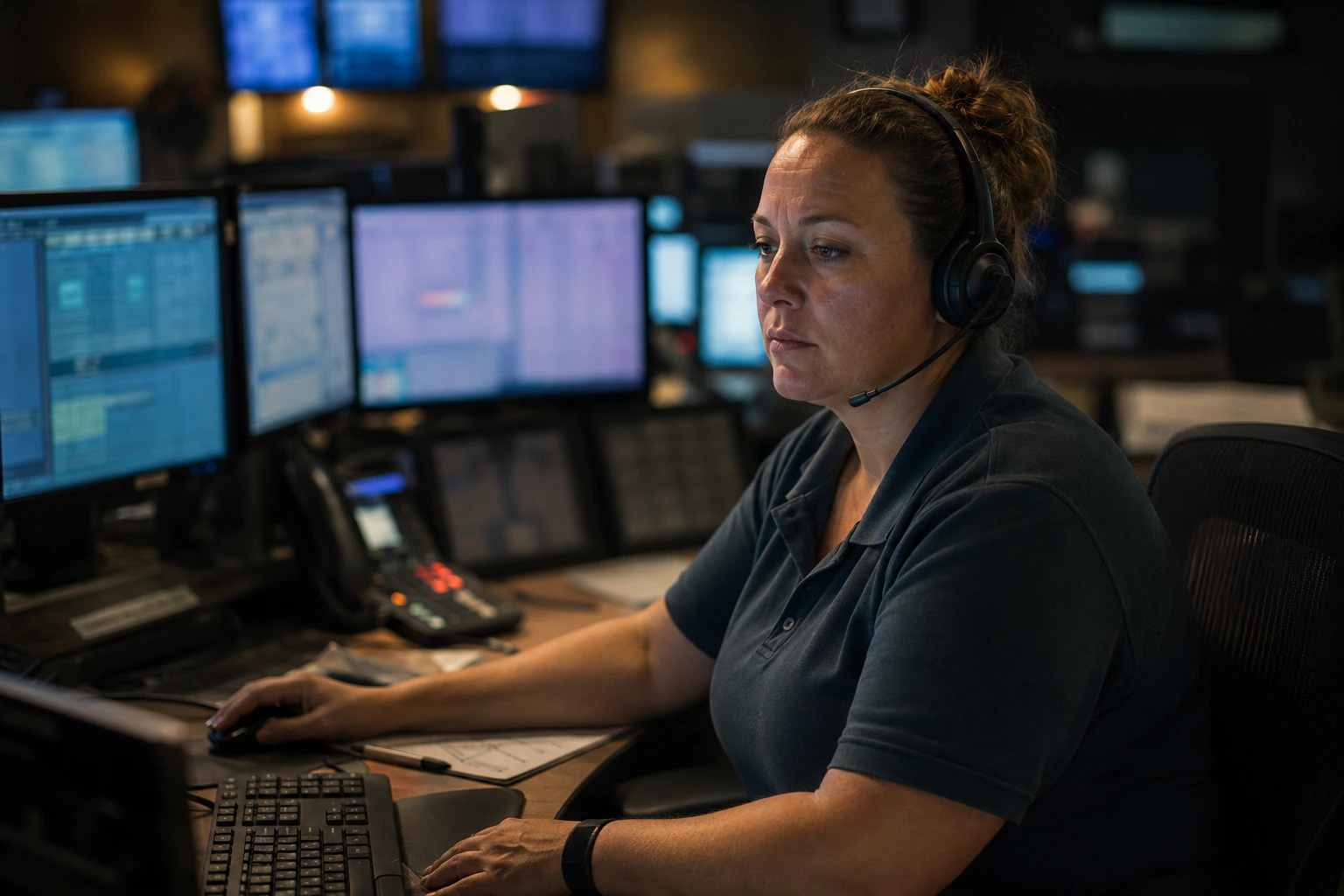
A full career should not require a lifetime behind the headset.
911 work can include urgent calls, rotating shifts, overtime, and decades of high-stakes decisions; conditions vary by employer and workplace. A.9162A/S.7635B would offer a 25-year retirement path only to workers who meet the bill's rules and whose eligible public employer elects the benefit.
AI-created campaign image; not a real incident or identifiable dispatcher.
45
Example: qualifying service under the proposal begins at 18; regular ERS Tier 6 full-benefit age is 63.
THE REGULAR ERS TIER 6 COMPARISON
A career that can span 45 years.
For a regular ERS Tier 6 member who begins qualifying 911 service under the proposal at 18, the full-benefit age is 63—a 45-year span. Earlier retirement may be available from age 55 with a permanent benefit reduction. We are asking New York to offer eligible 911 workers an optional retirement benefit after 25 years of qualifying service when their public employer elects to participate.
Change the starting age. See the qualifying-service timeline.
Choose an age when qualifying service under the proposal began. This shows the 25-year qualifying-service point beside age 63, the regular ERS Tier 6 full-benefit age.
The interactive comparison is loading. The example below starts qualifying service at age 18 and reaches 25 years of service at age 43.
1845
Starting point18Age qualifying service begins
25-year qualifying-service point43Age after 25 uninterrupted years of qualifying service
Regular Tier 663Full-benefit age
This is a career-length illustration, not a pension estimate or medical cutoff. The proposed benefit is service-based and sets no minimum retirement age; in this age-18 illustration, 25 years of uninterrupted qualifying service would be reached at age 43. That does not guarantee eligibility. Twenty-five years is the policy threshold chosen by the Legislature. Eligibility, qualifying service, an employer's election, and the controlling law determine whether the proposed plan would apply. Retirement policy is not a substitute for safe staffing, confidential mental-health care, peer support, or crisis services.
TIER 4, 5 & 6 TRANSPARENCY
Tier 6 is the lead example. It is not the whole story.
Regular ERS rules differ by membership date and tier. This comparison keeps the Tier 6 case clear while showing how Tier 4 and Tier 5 differ—without assuming every 911 professional has the same plan.
Joined Sept. 1, 1983–Dec. 31, 2009
Tier 4
Full benefit: age 62
From age 55: no reduction with at least 30 years. With fewer than 30 years, NYSLRS lists a 27% reduction at age 55.
Joined Jan. 1, 2010–Mar. 31, 2012
Tier 5
Full benefit: age 62
From age 55: generally a permanent reduction, even with 30 years. NYSLRS lists 38.33% at age 55. A narrow exception applies to certain Unified Court System members.
Joined April 1, 2012 or later
Tier 6
Full benefit: age 63
From age 55: a permanent reduction, even with 30 years. NYSLRS lists 52% at age 55.
WHY TIER 6 STILL LEADS
The bill is not limited to Tier 6.
Tier 6 remains the campaign's clearest regular-plan example because it shows the distance between 25 years of service and the age-63 full benefit. But A.9162A/S.7635B is not Tier 6-only. An eligible public employer must elect the benefit; covered Article 14 members would then have a separate one-year written, irrevocable election. The bill's coverage rules and NYSLRS—not tier alone—would control an individual case.
The proposal is service-based and sets no minimum retirement age. In a carefully limited illustration, 25 years of uninterrupted qualifying service beginning at 18 could be reached at age 43. That does not guarantee eligibility for any person.
Special plans, transfers, reinstatements, previous membership, certain Unified Court System service, and individual records can change the result. This comparison is not an individual pension estimate.
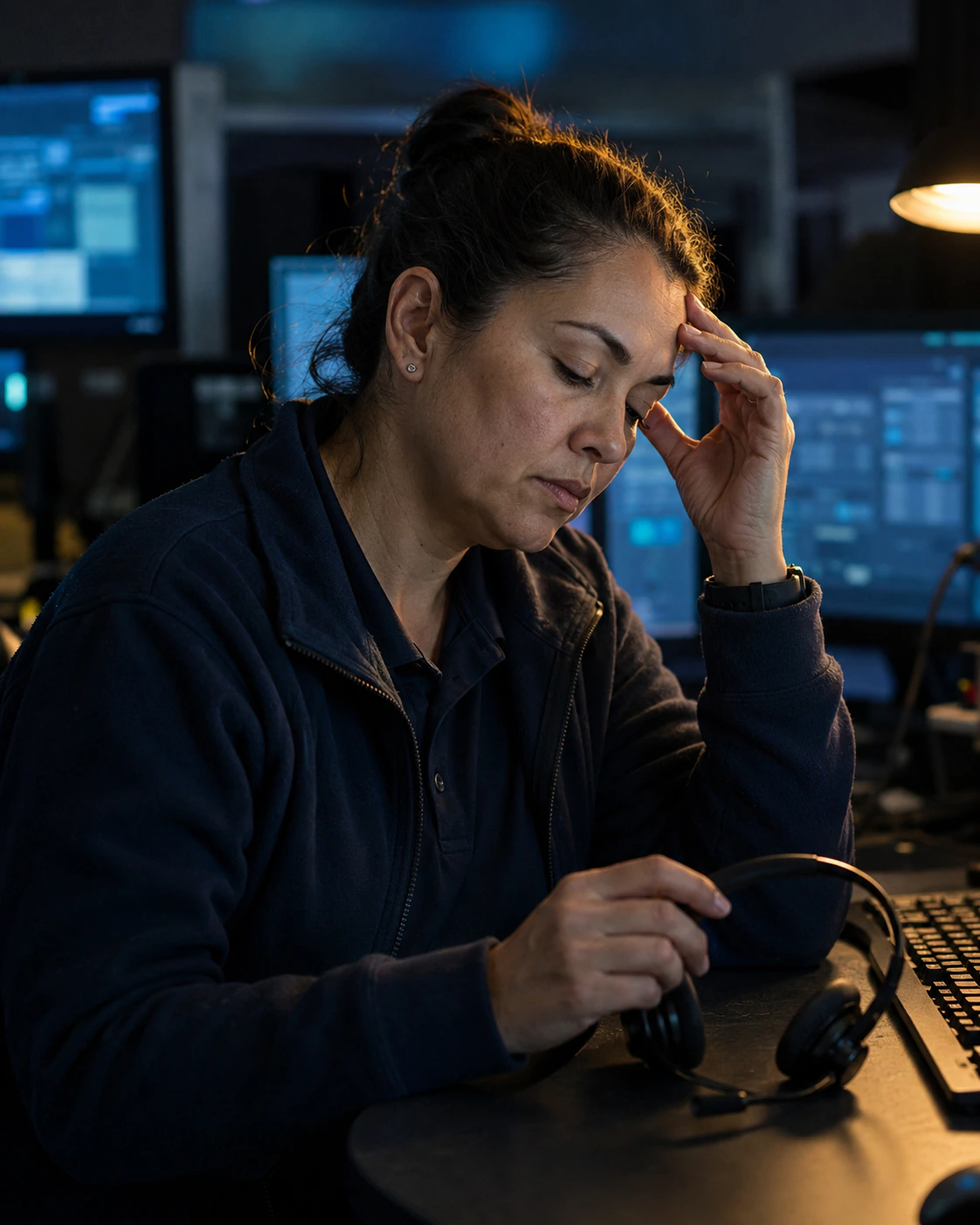
They may never stand at the scene. Some calls can stay with them.
A 2025 statewide needs assessment from SUNY New Paltz included 417 emergency communications respondents. Their answers document the cumulative burden of handling urgent calls, shift work and overtime without pretending that every person or workplace is the same.
80%Reported stress as a work-related mental-health challenge75%Reported burnout as a work-related mental-health challenge93%Reported work-related sleep disturbance
Read these figures carefully: They are self-reported results from the study's emergency communications subgroup. They are not clinical diagnoses, rates for every New York dispatcher, or proof that a retirement benefit would prevent a mental-health condition.
Where these numbers come from +
The New York State First Responder Mental Health Needs Assessment ↗ used a final weighted statewide sample of 6,003 first responders, including 417 emergency communications respondents. In that subgroup, 80% reported stress and 75% burnout as personal mental-health challenges resulting from first-responder work; 93% reported sleep disturbance. The report's separate composite symptom measures were 69% for anxiety symptoms, 73% for depression symptoms and 57% for PTSD symptoms. Those measures are not diagnoses. The same report found that 65% of emergency communications respondents identified overtime as a workplace stressor.
Workplace conditions matter. In a separate U.S. study of 403 911 telecommunicators, required mandatory-overtime hours were associated with higher self-reported stress symptoms, while voluntary overtime was not significantly associated. This is an association, not proof of causation. Read the mandatory-overtime study ↗ In a Washington sample of 324 telecommunicators, poor work-life integration and coworker conflict were associated with greater burnout, while job meaningfulness and greater visibility and inclusion were associated with lower burnout. Read the burnout study ↗
The work is also part of time-critical care. A systematic review of 33 observational studies found dispatcher-assisted CPR was consistently associated with better outcomes than no dispatcher-assisted CPR. The evidence was rated low or very low certainty, so this supports the dispatcher's time-critical role without guaranteeing an outcome in every call. Read the dispatcher-assisted CPR review ↗
Broader research provides additional context. A systematic review and meta-analysis considered 7,759 emergency and urgent call-handlers and dispatchers across nine countries and reported pooled symptom-screening estimates of 17.8% for PTSD, 28.2% for depression and 17.2% for anxiety. Those pooled figures are not diagnoses, New York-specific rates, or proof of a condition in any person. Read the study record ↗ A separate review covered 6,621 emergency telecommunicators across 31 studies, used different definitions and rated many prevalence findings as low-strength evidence. Read the additional review ↗ The related federal AHRQ evidence report and this 31-study review came from the same evidence project, so the campaign does not count them as independent confirmations. Read the federal evidence report ↗
AI-created campaign image; not a real incident or identifiable dispatcher.
WHY THIS IS PERSONAL
“
This campaign comes from service—and loss.
I have experienced the loss of a coworker. That loss stays with me. It is one reason this work matters so much.
No one loss has only one cause, and this bill is not a suicide-prevention measure or mental-health treatment. I have lived through trauma, too. I had to step back when years of stress became too much. I know from my own experience how hard it can be to leave the work at work.
I want the next generation of 911 professionals to have a more sustainable path through a full career. I believe a 25-year option would honor this work and could give eligible workers more life beyond a full emergency-communications career. It would remain retirement policy—not treatment, a wellness guarantee, or a substitute for safe staffing and confidential care.
I want to help the people who help you.
— Casey Howe, New York 911 supervisor and campaign organizer
If this subject brings up difficult feelings:Call or text 988 for free, private crisis support in the United States, or chat online. If there is immediate danger, call 911.
READY TO HELP?
Turn what you learned into one personal letter.
Governor Hochul needs to hear why a fair 25-year choice matters to dispatchers, families, first responders, and communities.